
The door you choose can completely change how your sauna feels. A glass door brings in light, opens up the space, and gives the room a cleaner, more contemporary look. Cedar creates a warmer, more private atmosphere and can be a better fit when insulation is a bigger priority, especially in an outdoor sauna. If you are deciding between the two, the right choice comes down to how you want the room to look and feel, where the sauna is being built, and how the door will work with the rest of your design.
For a DIY project, the decision also affects practical details such as the rough opening, jamb depth, hinge direction, heater sizing, and installation. When comparing sauna doors, think about how each option will work with the room itself, not just how it looks. A frameless glass door, a cedar door with a window, and a solid cedar door can each change the amount of light, privacy, insulation, and framing preparation your sauna needs. Sorting that out before you frame the opening can save you from having to rework the room later.
Glass vs. Cedar Sauna Doors at a Glance
Both styles can work well in a home sauna, but they solve different priorities. Glass emphasises light and visibility. Cedar emphasises privacy, insulation, and a traditional wood finish. Some cedar doors also include tempered-glass windows, so you do not have to choose between an entirely solid door and an entirely glass one.
| Priority | Glass door | Cedar door |
|---|---|---|
| Light | Maximum light and visibility | More enclosed; window options can add light |
| Privacy | Lowest with clear glass; tinted or frosted options add some screening | Higher, especially with a solid or smaller-window design |
| Heat retention | Large glass area should be considered in heater sizing | Cedar-lined construction can provide greater insulation than a full-window door |
| Look | Clean, open, contemporary | Warm, traditional, wood-forward |
| Outdoor use | Can work when the full room is properly planned | Sealed cedar options can be especially useful outdoors |
| Planning | Confirm glass style, jamb, opening, and heater impact | Confirm window style, jamb depth, opening, and hinge direction |
Why Choose a Glass Sauna Door?
A frameless glass door is a strong fit when you want the sauna to feel visually open. Clear glass gives you the most visibility, while bronzed, grey, or frosted options can soften the sightline and change the appearance of the room. On a smaller indoor sauna, that extra light can make the entrance feel less enclosed without taking up any additional floor space.
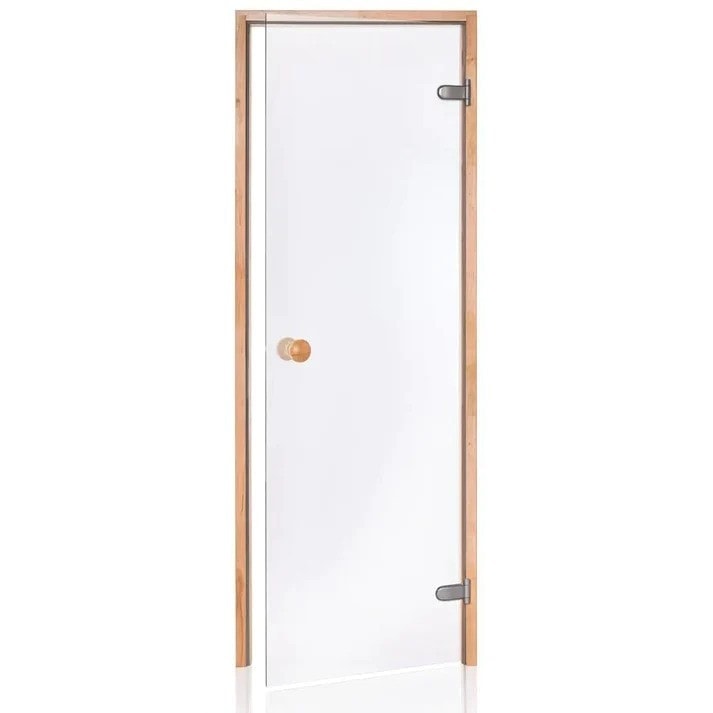
Our frameless glass door options are sold pre-hung in wood jambs, with the handle, hinges, and stop already installed. Depending on the model, the jamb may be cedar, alder, or black aspen, and current glass choices include clear, bronzed, grey, and frosted finishes. Pre-hung construction also gives you a defined door assembly to plan the rough opening around instead of building the jamb and hanging the glass separately.
The trade-off is that a large glass surface does not insulate the same way as a cedar-lined door. Glass and other uninsulated surfaces are commonly considered when calculating the effective room volume for heater sizing, so a full-glass door should be part of the heater conversation rather than treated as a purely cosmetic choice.
Why Choose a Cedar Sauna Door?
A pre-hung cedar door is a practical choice when privacy and heat retention carry more weight in your project. Our current cedar door uses a hollow-core construction with an air gap, weatherproof sealing on all four sides, and no air gap underneath. This construction provides a greater level of insulation than a full-window door, which makes it especially useful for outdoor saunas.
Cedar also keeps the doorway visually connected to the rest of a cedar-lined room. If you want natural wood to remain the dominant material, a cedar door can make the entrance feel like part of the sauna rather than a separate architectural feature. You can still bring in light with a half-window configuration, or choose a solid option when privacy is the priority.
There is also a middle ground. Our full-window cedar door combines a Western Red Cedar door structure with a large tempered-glass panel, so you can bring in more light while keeping a traditional cedar frame and finish.

What Should You Measure Before Ordering?
Door style should be decided before you finish the opening. Current models use different rough openings, jamb depths, and hinge configurations, so the exact product specifications need to guide the framing. Before requesting a quote or finalising the wall, confirm:
- the finished rough-opening width and height required by the exact door
- the finished wall thickness and whether a jamb extender will be needed
- the hinge direction and the clear space available for the door swing
- whether the sauna is indoors or outdoors
- how much glass will be in the door and elsewhere in the room
How the Door Can Affect Heater Sizing
If you are using a full-glass door or adding other large glass surfaces, include them when you confirm the heater for the room. The base calculation starts with the finished interior volume, but glass, masonry, and other uninsulated surfaces can increase the heating demand.
That does not mean you should automatically buy a larger heater. The correct approach is to compare the completed room, including the door and any windows, with the sizing range and installation requirements of the exact heater you plan to use. If the room is outdoors, cold-weather exposure and the overall insulated envelope should also be part of that decision.
Which Door Is Better for Your DIY Sauna?
Choose the door that fits the priorities of the room rather than looking for one universal winner. A frameless glass door is often the better fit when you want maximum light, visibility, and a contemporary look. A cedar-lined or solid cedar door makes more sense when you want stronger privacy, a more enclosed traditional feel, or additional insulation for an outdoor sauna.

If you want some of both, a cedar door with a tempered-glass window is an easy compromise. You keep more cedar in the room while still bringing light through the entrance. The important part is choosing the door early enough that the rough opening, heater selection, and wall construction can be planned around the actual assembly.
Find the Right Sauna Door for Your Build
We carry several door configurations for DIY sauna projects, including frameless glass doors in multiple jamb and glass finishes, cedar doors with half windows, full-window cedar doors, and solid cedar options. Our sauna kit builder also lets you select the door type while you work through room dimensions, benches, heating, controls, flooring, and accessories.
At Home Sauna Kits, we can help you compare the current door options against your room dimensions, indoor or outdoor location, preferred level of privacy, and the rest of your sauna design. If you already know your rough opening, send us the measurements. If you are still planning the room, use our builder or contact us before framing so the door, heater, and interior kit can be coordinated together.